
 Login
LoginHow AI Revenue Infrastructure Helps Industrial Sales Teams Move Faster

Move faster is the most common request in industrial sales. It is also the most misunderstood.
When teams hear faster, they usually think rush. Push harder, work later, chase more. That effort helps for a week or two and then the same delays return, because the real problem was never how fast people work. It was how long deals spend waiting between the steps.
That waiting is exactly what AI Revenue Infrastructure is designed to remove. Not by making people rush, but by taking the pauses out of the process.
Speed Is Not About Rushing
A quote sent quickly on a half-understood requirement is not fast. It comes back as a clarification, a revision, and a re-quote. What looked fast on Monday becomes the slowest path to close by the end of the month.
Real speed in industrial sales is not about compressing the care that goes into a quotation. It is about compressing the time a deal spends sitting still between one step and the next. That is where the days actually disappear.
Where Industrial Deals Actually Lose Time
Trace a slow deal back through its history and something becomes clear. The time was not lost in the doing. It was lost in the gaps between.
The enquiry sits in an inbox before anyone structures it. The quote waits on one missing input. The approval waits for someone to notice it needs signing. The follow-up waits for someone to remember it is due. In each case, the actual work takes minutes. The waiting around it takes days.
This waiting is invisible on a dashboard, which simply shows the deal parked in a stage. That is why it persists, deal after deal, even in teams that are working hard. Nobody can fix a delay they cannot see.
What AI Revenue Infrastructure Actually Is
AI Revenue Infrastructure is not another CRM, and it is not a dashboard. It is an execution layer that sits in the stretch between inquiry and order and acts on the workflow, rather than only displaying it.
In plain terms, instead of waiting for a person to move each step by hand, it helps move the steps. It captures and structures the enquiry when it arrives. It helps assemble the quote from the right inputs and keeps one current version. It routes the approval and keeps it moving. It keeps the follow-up alive. People still make every decision. The infrastructure carries the operational work in between the decisions.
How It Helps Teams Move Faster
The gains show up at exactly the points where deals used to sit and wait.
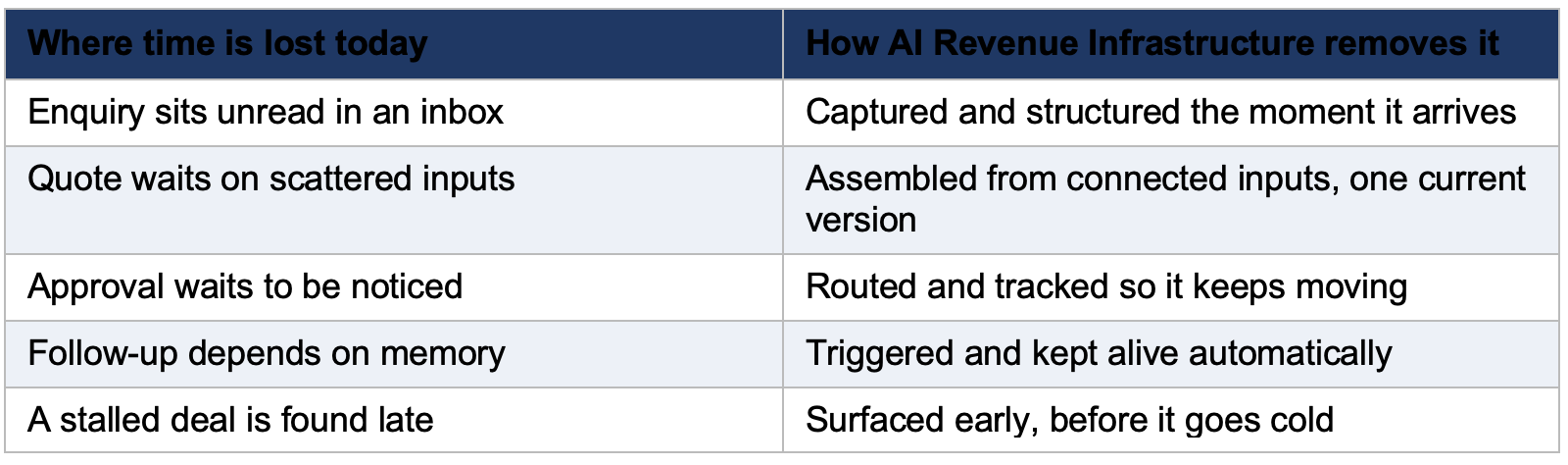
None of this replaces the judgment of the sales team. It removes the dead time around that judgment, so the same people close more of the deals they already have.
Why Speed Compounds
Faster execution is not only an internal efficiency. It is something the buyer feels directly.
In most industrial purchases, the buyer sends the enquiry to more than one vendor and quietly watches who responds first and best. Across B2B sales, a large share of deals go to the vendor who responds first, because the first credible response shapes the decision before competitors have replied.
Buyers are also less patient than they used to be. McKinsey's 2026 Global B2B Pulse found that buyers now use around ten channels across a single purchase and increasingly switch suppliers when responses are slow or inconsistent. At the same time, Salesforce reports that sales reps spend about 60 percent of their time on non-selling work such as data entry and preparing quotes. Every hour lost to that manual coordination is an hour not spent winning the deal.
So removing the waiting does two things at once. It frees the team from low-value coordination, and it gets a clear response to the buyer while the decision is still open. Speed stops being a scramble and becomes a structural advantage.
How MiClient Helps
MiClient works as AI Revenue Infrastructure for industrial sales teams. It helps move the inquiry-to-order stretch as one connected flow, capturing and structuring the enquiry, keeping a single current quote, moving approvals, and keeping follow-ups alive.
The team keeps the relationships, the technical judgment, and the final call. MiClient carries the operational work in between, so deals move at the speed of the business, not the speed of whoever remembers to chase them.
Conclusion
Industrial sales teams do not get faster by working harder. They get faster by removing the waiting that sits between every step of a deal.
That is what AI Revenue Infrastructure is for. Not rushing the work, but taking the pauses out of it, so the deals you have already earned move with speed, clarity, and control, and the buyer hears from a vendor who is ready rather than one still catching up.
FAQs
- What is AI Revenue Infrastructure?
It is an execution layer that sits between inquiry and order and acts on the sales workflow, helping capture enquiries, assemble quotes, move approvals, and keep follow-ups alive, rather than only recording them like a CRM.
2. Does moving faster mean sending quotes more quickly?
Not exactly. A fast but inaccurate quote creates revisions that cost more time. Real speed comes from removing the waiting between steps, so an accurate response reaches the buyer without long silences.
3. Where do industrial deals usually lose the most time?
In the gaps between steps, not the steps themselves. Enquiries wait to be read, quotes wait on inputs, approvals wait to be noticed, and follow-ups wait to be remembered.
4. Does this replace the sales team?
No. People keep the relationships, the technical judgment, and the decisions. AI Revenue Infrastructure removes the manual coordination around those decisions.
5. How does MiClient help industrial sales teams move faster?
MiClient works as AI Revenue Infrastructure, moving the inquiry-to-order stretch as one connected flow so deals do not sit idle between steps.
Sources referred:
Salesforce, 40 Sales Statistics to Watch for in 2026
McKinsey, 2026 Global B2B Pulse
Industry compilations of B2B first-responder and lead response statistics, 2025 to 2026