
 Login
LoginCRM vs AI Revenue Infrastructure: What Industrial Sales Teams Really Need

Most industrial sales teams already have a CRM. Many of them are still fighting the same problems: quotes that move slowly, approvals that get stuck, follow-ups that slip, and deals that look active while quietly standing still.
That is not a sign the CRM was a mistake. It is a sign that CRM was built to do one job, and industrial teams now need a different one. CRM was built to record the deal. What is missing is something that helps execute it.
Record Versus Execute
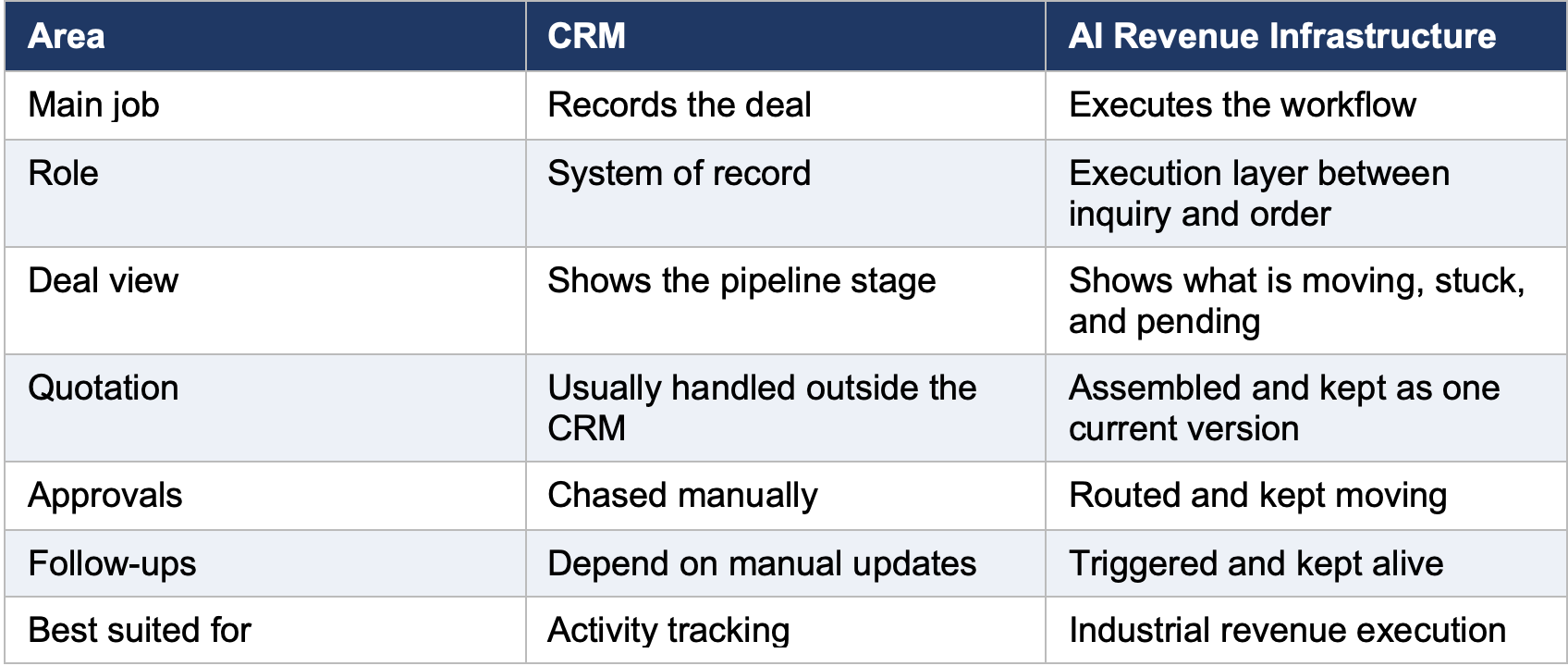
A CRM is a system of record. It stores contacts, accounts, pipeline stages, notes, and activity history. It gives leadership a clear view of what exists and what stage it is in. That is genuinely useful, and it is not going away.
But recording a deal is not the same as moving it. Between an inquiry arriving and an order being placed, there is real operational work: understanding the requirement, assembling the quote, moving the approval, and keeping the follow-up alive. A CRM can show that this work is pending. It cannot do it.
AI Revenue Infrastructure is the other category. It is an execution layer that acts on that work, rather than only reflecting it. Where the CRM records the deal, AI Revenue Infrastructure helps carry it forward.
Why CRM Alone Is Not Enough for Industrial Sales
Industrial sales is not a simple lead-to-close journey. It is a technical, commercial, and operational workflow.
That workflow looks broadly the same across B2B business models. A manufacturer, a wholesaler, and a distributor all face the same core challenge: a technical requirement arrives, several functions have to weigh in, and a quotation has to reach the customer before the opportunity cools. The complexity is greatest in industries such as HVAC, BMS, energy, life sciences, and medical devices, where specifications are detailed and approvals pass through several hands.
A CRM may show that a deal is in the quotation stage. But it does not show which specification is still pending, whether engineering has reviewed the requirement, which quote version is current, or where the approval is stuck. And even where it shows these things, it cannot act on any of them. It tracks the pipeline. It does not execute the workflow behind it.
What AI Revenue Infrastructure Is
AI Revenue Infrastructure is the execution layer for the stretch between inquiry and order, the part of the revenue process that neither ERP nor CRM truly owns. ERP takes over once an order exists. CRM records the relationship alongside it. The commercial work in between, the quote, the approval, the follow-up, is what AI Revenue Infrastructure is built to run.
A simple comparison captures the difference in role. An AI assistant or copilot helps one person work a little faster, like a copilot supporting one pilot in one aircraft. AI Revenue Infrastructure works at the level of the whole system, more like air traffic control, coordinating every deal in motion so nothing collides and nothing is forgotten. One helps an individual. The other keeps the entire revenue operation moving.
CRM vs AI Revenue Infrastructure
Why This Shift Matters Now
The pressure on industrial sales teams is rising from both sides.
Internally, teams are overloaded. Salesforce reports that sales reps spend about 60 percent of their time on non-selling tasks and use an average of eight tools to close a deal. Gartner's 2024 sales survey found that half of sellers feel overwhelmed by the amount of technology they are expected to use, and that overwhelmed sellers are 45 percent less likely to hit quota. More tools and more dashboards have not solved the problem, because they add to the visibility without reducing the manual work.
Externally, buyers have less patience. McKinsey's 2026 Global B2B Pulse found that buyers now move across around ten channels in a single purchase and switch suppliers when the experience is slow or inconsistent. A system that only records the deal cannot keep pace with a buyer moving that fast. A system that helps execute it can.
How MiClient Helps Industrial Sales Teams
MiClient is built as AI Revenue Infrastructure for industrial sales. It does not ask teams to throw away the CRM. It works alongside the systems of record and takes on the execution they were never built to handle, coordinating the inquiry-to-order stretch as one connected flow.
It helps capture and structure the enquiry, assemble and maintain a single current quote, move approvals, and keep follow-ups alive, while leadership sees what is genuinely moving rather than only what is listed. The team keeps the decisions. MiClient carries the operational work in between.
Conclusion
CRM is important, and for industrial sales teams it is still necessary. But it is no longer sufficient on its own. A CRM records the deal. It does not move it.
What industrial revenue teams need alongside it is an execution layer, AI Revenue Infrastructure, that owns the stretch between inquiry and order and actually carries the work forward. That is the difference between a pipeline you can see and a pipeline that moves.
FAQs
- What is the difference between CRM and AI Revenue Infrastructure?
A CRM records the deal: contacts, stages, and activity. AI Revenue Infrastructure is an execution layer that acts on the workflow between inquiry and order, helping assemble quotes, move approvals, and keep follow-ups alive.
2. Does AI Revenue Infrastructure replace the CRM?
No. It works alongside the CRM and ERP, taking on the execution of the inquiry-to-order stretch that neither system was built to own.
3. Why is CRM alone not enough for industrial sales?
Industrial sales involves technical requirements, costing, approvals, quotations, and multiple internal teams. A CRM records this but cannot move it, so deals stall in the coordination between steps.
4. How is this different from an AI copilot?
A copilot helps one person work faster. AI Revenue Infrastructure works at the level of the whole revenue system, coordinating every deal in motion, closer to air traffic control than to a personal assistant.
5. Which industries and business models does MiClient serve?
MiClient supports B2B organisations across manufacturing, wholesale, and distribution business models, with a focus on HVAC, BMS, energy, life sciences, and medical devices.
6. Who should use MiClient?
Industrial sales teams, quotation and commercial teams, revenue operations teams, and CXOs who need execution, not just visibility.
Sources referred:
Salesforce, 40 Sales Statistics to Watch for in 2026
Gartner, Sales Survey, 2024
McKinsey, 2026 Global B2B Pulse