
 Login
LoginCRM vs Revenue Operating System: What Industrial Sales Teams Really Need

Most industrial sales teams already have a CRM.
But many of them are still struggling with the same problems.
RFPs/Enquiries are scattered. Quotations are delayed. Approvals are unclear. Follow-ups depend on memory. Leadership sees pipeline value, but not execution reality.
This is where the real gap begins.
A CRM can show that a deal exists. It records customer details, pipeline stages, meeting notes, and follow-up activity. That is useful.
But in industrial sales, the real challenge is not recording the deal.
It is moving the deal.
A serious RFP/Enquiry does not become revenue just because it has been entered into a CRM. It has to move through requirement understanding, engineering, costing, commercial review, approval, quotation, follow-up, and leadership visibility.
That entire movement is revenue execution.
And for many industrial teams, that execution still happens outside the CRM, by hand.
Record, Advise, Execute: Three Different Jobs
It helps to separate three things software can do, because they are often confused.
A system of record stores what happened. That is the CRM.
A system of intelligence advises. It uses predictive analytics, win probability modeling, and next best action engines to forecast, score, flag risk, and recommend.
A system of execution carries out the operational work through autonomous AI agents. That is the newer and more important shift.
The distinction is simple but decisive.
A CRM can tell you a deal is in the quotation stage. An intelligence layer can tell you it looks at risk.
Neither actually assembles the quotation, orchestrates the approval, or executes the follow-up.
Only an agentic system built to execute does that.
A Revenue Operating System belongs in this third category. It is an AI-native, agentic execution layer, not a smarter filing cabinet and not just a recommendation engine.
Inside a Revenue Operating System: The Agentic Architecture
What makes a Revenue Operating System different is not a single AI feature. It is the architecture underneath.
Rather than one model answering prompts, it runs a multi-agent architecture, where specialised autonomous AI agents each own a stage of the revenue workflow and operate in parallel under an AI orchestration layer.
An RFP/Enquiry intelligence agent applies intelligent data extraction and semantic understanding to turn a raw requirement, drawing, or BOQ into structured, quote-ready data.
A quote intelligence agent assembles the quotation from the right technical and commercial inputs.
An approval orchestration agent routes and tracks sign-offs across engineering, costing, and commercial functions.
A follow-up agent executes and tracks the next customer action.
A deal risk agent applies revenue signal detection to flag opportunities losing momentum. A commercial knowledge graph gives every agent shared context across requirements, quotations, approvals, and customer signals, while a human-in-the-loop design keeps commercial decisions with the team.
Why CRM Alone Is Not Enough for Industrial Sales
Industrial sales is not a simple lead-to-close journey. It is a technical, commercial, and operational workflow.
That workflow looks broadly the same across B2B business models. A manufacturer, a wholesaler, and a distributor all face the same underlying problem: a technical requirement arrives, several functions must weigh in, and a quotation has to reach the customer before the opportunity cools.
The complexity is greatest in industries such as HVAC, BMS, energy, life sciences, and medical devices, where specifications are detailed, compliance matters, and approvals pass through several hands.
A customer may send a technical requirement, drawing, BOQ, specification, or tender document. The sales team cannot respond alone. Engineering checks feasibility. Costing prepares numbers. Commercial teams review margins. Leadership may approve pricing. The customer expects a clean quotation and timely follow-up.
A CRM may show the deal is in the quotation stage.
But does it show which specification is pending? Does it know whether engineering has reviewed the requirement? Does it connect the latest costing input with the quotation version? Does it show where approval is stuck? Does it help the team act before the customer goes quiet?
This is why CRM alone is not enough.
It tracks the pipeline. It does not execute the workflow behind it.
The Real Work Happens Around the CRM
In many industrial businesses, the CRM is only one part of the system.
The RFP/Enquiry is in email. The pricing is in Excel. The clarification is on WhatsApp. The approval is in a separate thread. The quotation version is in a shared folder. The CRM is updated later.
The dashboard says the deal is active.
But the team still does not know what is actually pending.
This is where revenue leakage begins.
Not as a dramatic lost deal, but as slow movement, weak follow-up, unclear ownership, delayed approvals, and reactive leadership reviews.
The problem is not that teams are not working.
The problem is that the work is fragmented, and no system is actively orchestrating the execution forward.
What Is a Revenue Operating System?
A Revenue Operating System is not just another sales tool.
It is an AI-native, agentic execution layer that helps industrial sales teams move revenue from RFP/Enquiry to quotation to approval to follow-up to closure.
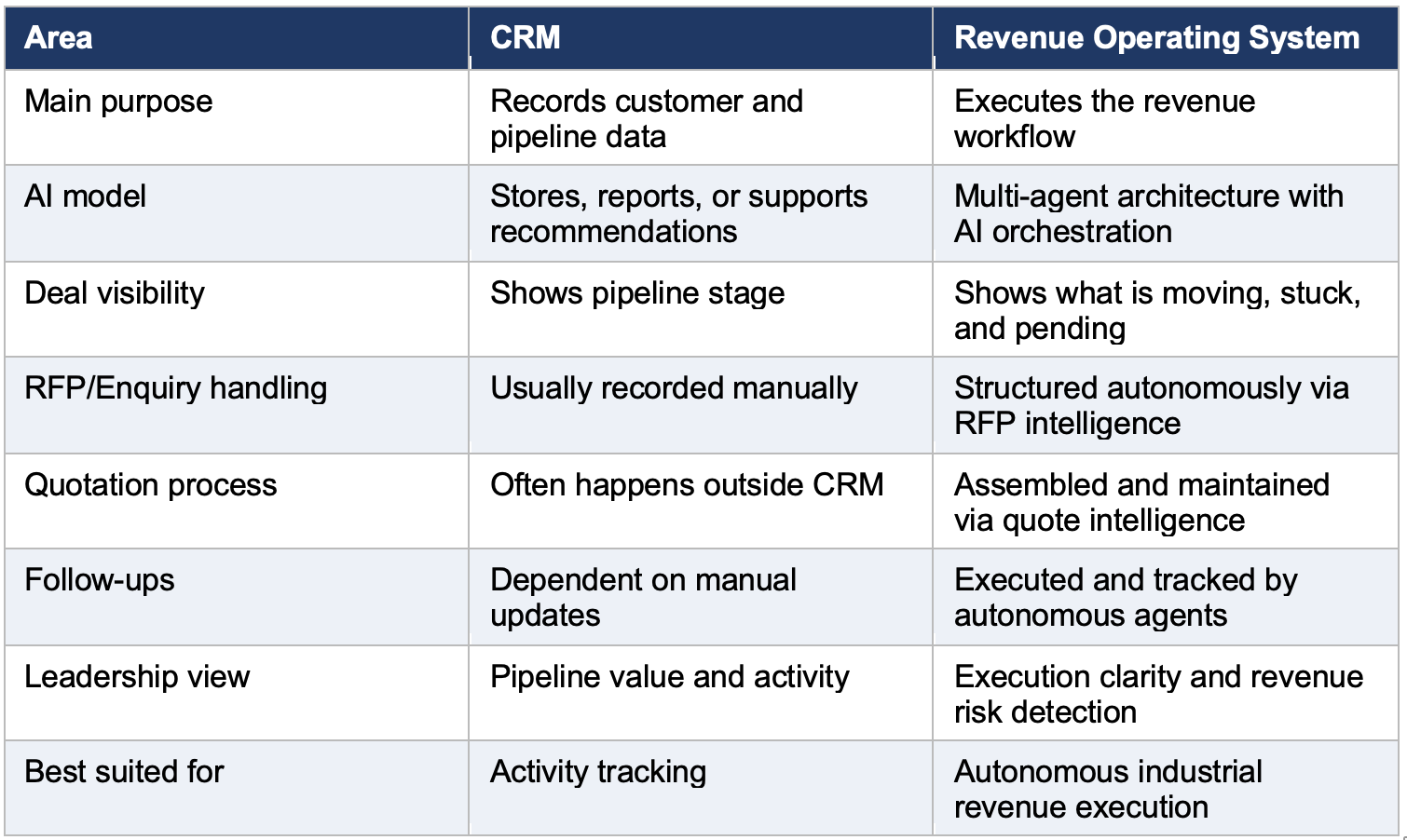
Where a CRM records what happened, and an intelligence layer recommends what to do, a Revenue Operating System deploys autonomous agents to carry out the operational work: applying RFP/Enquiry intelligence, running quote intelligence, orchestrating approvals, executing follow-up actions, and monitoring open deals through revenue signal detection.
The team stays in control of every commercial decision.
The agents carry the operational coordination in between.
The goal is not to replace sales teams. It is to give sales, quotation, commercial, and leadership teams one agentic execution layer that performs the operational work they would otherwise manage manually.
CRM vs Revenue Operating System
Why This Shift Matters Now
Sales teams are already overloaded.
Salesforce reports that sales reps spend 60 percent of their time on non-selling tasks, and that sellers use an average of eight tools to close deals.
Gartner's 2024 sales survey found that 50 percent of sellers are overwhelmed by the amount of technology needed, and overwhelmed sellers are 45 percent less likely to attain quota.
In industrial sales, this manual load becomes even sharper because every serious opportunity depends on multiple people and multiple steps.
Buyers have moved the other way.
McKinsey's 2026 Global B2B Pulse found that buyers now use an average of ten channels across the purchasing journey, and that inconsistent information and lack of knowledgeable support are leading drivers of supplier switching.
A system that only records or advises cannot keep pace with that.
An agentic system that executes can.
How MiClient Helps Industrial Sales Teams
MiClient is built for industrial sales teams that need more than a CRM and more than an AI copilot.
It works as an AI-native, agentic execution layer, an Industrial Revenue Infrastructure powered by a multi-agent architecture that applies RFP/Enquiry intelligence, runs quote intelligence, orchestrates approvals, executes follow-up actions, and surfaces where revenue risk is building.
MiClient supports B2B organisations across manufacturing, wholesale, and distribution business models, with particular focus on HVAC, BMS, energy, life sciences, and medical devices.
For sales, that means less chasing. For quotation teams, clearer ownership. For commercial teams, approvals that move with better context. For leadership, real execution visibility.
MiClient helps industrial teams move from activity tracking to autonomous revenue execution.
Not as another CRM.
As AI Revenue Infrastructure and a Revenue Operating System for industrial revenue teams.
Conclusion
CRM is important.
But for industrial sales teams, CRM is no longer enough.
A CRM records the deal. Industrial revenue teams also need a system of autonomous agents that knows what is blocking the deal and moves the operational work forward: which quotation is current, where approval is pending, what follow-up is needed, and whether the customer is still engaged.
That is the shift from CRM to a Revenue Operating System. From recording and advising to autonomous execution.
MiClient is built for that shift.
Because in industrial sales, revenue is not won only by having a strong pipeline.
It is won by making that pipeline move.
FAQs
- What is a Revenue Operating System?
It is an AI-native, agentic execution layer built on autonomous AI agents that helps industrial sales teams carry out the operational work of revenue, from RFP/Enquiry capture through quotations, approvals, follow-ups, and revenue visibility, while people stay in control of decisions.
2. How is it different from a CRM?
A CRM records customer data and pipeline stages. A Revenue Operating System uses a multi-agent architecture to execute the workflow behind the deal, structuring enquiries, assembling quotations, orchestrating approvals, executing follow-ups, and detecting deal risk.
3. Is this the same as an AI copilot?
No. An AI copilot advises or suggests. A Revenue Operating System is agentic. Its autonomous agents perform the operational work, coordinated by an AI orchestration layer, while the team supervises and makes the decisions.
4. What does the multi-agent architecture actually do?
Specialised agents each own a stage of the workflow: RFP/Enquiry intelligence, quote intelligence, approval orchestration, follow-up execution, and deal risk detection. They share context through a commercial knowledge graph and run under human-in-the-loop supervision.
5. Which industries and business models is this suited to?
MiClient works across B2B business models, including manufacturing, wholesale, and distribution. Its focus industries are HVAC, BMS, energy, life sciences, and medical devices, where technical requirements and long approval chains make execution hardest.
6. Who should use MiClient?
Industrial sales
teams, quotation and proposal teams, commercial teams, revenue operations teams, and CXOs who need autonomous execution, not just visibility.
Sources referred:
Salesforce, 40 Sales Statistics to Watch for in 2026
Gartner, Sales Survey, 2024
McKinsey, 2026 Global B2B Pulse