
 Login
LoginHow AI-Powered Quotations Help Industrial Sales Teams Respond to RFPs/Enquiries Faster

In industrial sales, the quotation is not just a document. It is the first real proof of how a vendor works.
Long before any price negotiation, the buyer has already formed an impression. How quickly did the response come? Did it show that the requirement was understood? Was it accurate, or did it need three corrections? In complex B2B sales, the quotation answers all of these questions at once.
That is why quotation speed matters so much, and why it is so often misunderstood. Most teams treat a slow quote as a deadline they missed. In reality, it is a signal the buyer received.
Why the Quotation Carries So Much Weight
A quotation in industrial sales is rarely a single number on a page. It usually reflects a configuration, a set of technical assumptions, a pricing structure, commercial terms, and sometimes compliance or delivery conditions. This is true across manufacturing, automation, BMS/HVAC, industrial equipment, medical devices, energy solutions, EPC, infrastructure, and other complex B2B sectors.
Because it carries all of that, the quotation becomes a test of the vendor’s competence. A clear, accurate, timely quote suggests a team that understands the requirement and can be trusted with the order. A slow or repeatedly corrected one suggests the opposite, even when the underlying capability is strong.
And buyers act on that impression. McKinsey’s 2026 Global B2B Pulse research, based on responses from nearly 4,000 decision makers, found that inconsistent information and a lack of knowledgeable, responsive support are now among the leading reasons B2B buyers switch suppliers. Earlier Pulse research put a number on it: more than half of B2B buyers said they would walk away from a supplier after a poor experience. In other words, the quotation is not only how you respond. It is part of how you are judged.
Speed Is Not the Real Problem. Quote-Readiness Is.
When quotes go out late, the usual reaction is to push the team to work faster. But speed was rarely the real bottleneck.
A quote sent quickly on a requirement that was not fully understood is not a win. It comes back as a revision, a clarification, and a re-quote. What looked fast becomes the slowest path of all.
The better target is not how fast can we send it. It is how fast can we become quote-ready.
Quote-readiness means knowing, before the quote moves, what is clear in the requirement, what is missing, what needs validation, what could affect pricing, and what must be confirmed first. A team that reaches that clarity quickly does not have to rush. The quote moves fast because there is nothing left to second-guess. This is the shift AI-powered quotation management actually delivers. Not typing faster, but reaching readiness sooner.
Where AI Changes the Quotation Workflow
AI-powered quotations help at the part of the process that usually causes the delay: turning a raw RFP/Enquiry into a structured, quote-ready view.
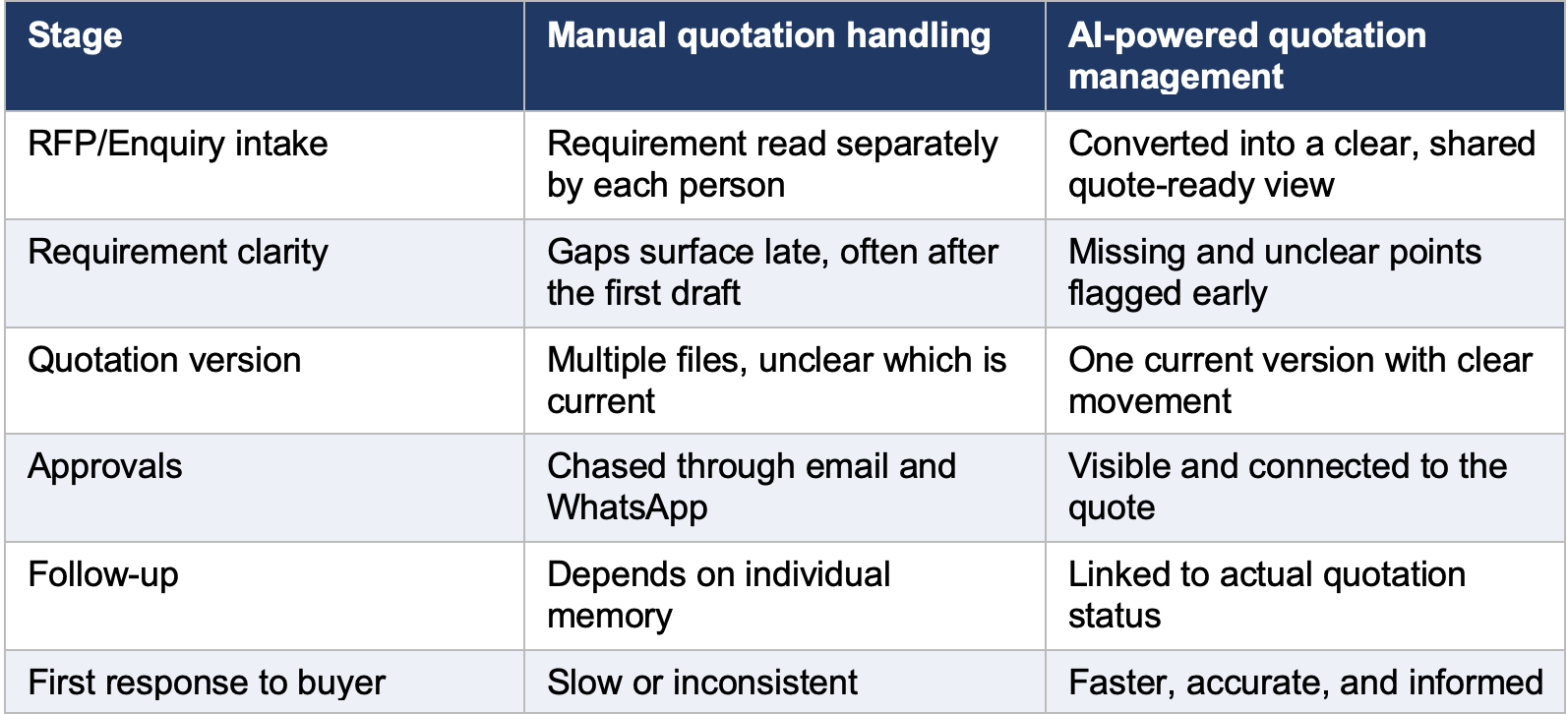
Instead of a requirement sitting as an attachment that several people read separately, AI can help convert it into a clearer picture: the key needs, the open questions, the technical points that need checking, and the commercial conditions that will shape the price. The team starts from clarity instead of assembling it from scratch.
From there, the quotation itself becomes more controlled. There is a current version rather than five competing files. Approvals are visible rather than buried in a chat. Follow-ups connect to the actual movement of the quote rather than depending on someone’s memory. The value is not speed alone. It is clarity at speed.
Before vs After AI-Powered Quotations
Why This Matters More Now
The pressure on quotation speed is not staying still. It is rising.
B2B buyers now move across an average of ten interaction channels in a single purchase, and they expect consistent, knowledgeable responses at every one of them. In some markets the number is higher; buyers in India, for example, use around eleven. Each additional channel is one more place where a slow or unclear quotation becomes visible.
At the same time, internal capacity is under strain. Salesforce reports that sales reps spend about 60 percent of their time on non-selling work, including preparing quotes and entering data, rather than engaging customers. When so much effort goes into the mechanics of quoting, the quality and speed of the actual response suffers. AI-powered quotation management helps close that gap, by reducing the manual load and helping teams respond with clarity while the buyer is still deciding.
How MiClient Helps Industrial Sales Teams Quote Faster
MiClient brings the quotation workflow into one connected system, so industrial sales teams can move from a raw RFP/Enquiry to a quote-ready response without losing time to scattered tools.
It helps teams capture the requirement clearly, keep a single current quotation version, make approvals visible, and connect follow-ups to the real movement of the quote. The result is not just a faster document, but a faster, cleaner, more confident first response, which is what the buyer is actually evaluating.
MiClient positions this as AI Revenue Infrastructure for industrial revenue teams, with the quotation workflow as one connected part of it, rather than another disconnected tool.
Conclusion
In industrial sales, the quotation is one of the earliest and clearest signals a buyer receives. A fast, accurate, well-understood quote builds confidence. A slow or repeatedly corrected one quietly erodes it.
The goal is not simply to quote faster. It is to become quote-ready faster, so that speed comes with clarity rather than at the cost of it. That is what AI-powered quotation management makes possible, and what MiClient is built to support for industrial sales teams.
FAQs
- What is AI-powered quotation management?
It is a connected, AI-assisted way of managing the journey from RFP/Enquiry to quotation, including requirement clarity, quotation versions, approvals, and follow-ups, so the response is faster and more accurate.
2. How does AI help industrial sales teams quote faster?
AI helps convert a raw requirement into a clear, quote-ready view, flagging what is missing or unclear early, so the team reaches readiness sooner instead of rushing a quote that later needs correction.
3. What does quote-ready mean in industrial sales?
Quote-ready means knowing what is clear in the requirement, what is missing, what needs validation, what could affect pricing, and what must be confirmed before the quotation moves forward.
4. Why do manual quotation workflows slow teams down?
When pricing sits in Excel, clarifications happen on WhatsApp, and approvals move through email, there is no single current version. Teams spend time reconciling tools instead of responding to the buyer.
5. Is faster quoting only about speed?
No. A fast quote on a misunderstood requirement creates revisions and re-quotes. The real goal is clarity at speed, where the response is both quick and accurate.
6. How does MiClient support quotation management?
MiClient connects RFPs/Enquiries, quotations, approvals, follow-ups, customer intelligence, and revenue visibility in one system, helping industrial sales teams move from a raw enquiry to a quote-ready response faster.
Sources referred:
Salesforce, 40 Sales Statistics to Watch for in 2026
McKinsey, 2026 Global B2B Pulse (B2B buyers reset the bar)